MINNEAPOLIS, MN – The global food supply chain is facing an unprecedented convergence of vulnerabilities. Topsoil depletion, chemical-heavy industrial agricultural models, geopolitical instability, and extreme weather disruptions are forcing a systemic reckoning. Consumers, communities, and institutional developers are actively demanding a shift toward decentralized, organic, toxin-free food security. Yet, the traditional landscaping and agricultural sectors have historically lacked the specialized enterprise systems required to scale decentralized ecological solutions efficiently.
Enter Food Forest Design Minnesota and the Food Forest Design Network.
By fusing deep permaculture architecture with a proprietary, AI-driven automation and CRM infrastructure, this venture is systematically transitioning residential yards, commercial real estate, and municipal spaces into high-yield, low-maintenance edible ecosystems. Engineered specifically to eliminate the structural flaws of first-generation green startups, the model introduces a disruptive, high-velocity vertical market to the multi-billion-dollar landscaping industry. Within 12 months of its national rollout, the platform is positioned to become the fastest-growing business model in the decentralized agricultural marketplace.
The Market Pain Points & The Governance Lesson
The investment marketplace features many companies that raised millions on the vague promise of an ecological revolution but failed on operational execution. While industrial agriculture remains dangerously centralized, the localized alternative, permaculture design and installation, has remained highly fragmented.
1. The Operational Bottleneck
Thousands of highly skilled professionals hold Permaculture Design Certificates (PDCs), yet struggle to build viable commercial enterprises. They are buried under backend administrative friction, which includes lead nurturing, invoicing, customer relationship management, and digital marketing. Because they spend 80% of their operational hours running an unoptimized business, they have only 20% left to focus on their core competency: designing and installing food forests.
2. Structural Lessons from First-Generation Failures
The proof of concept for a national permaculture network has already been established. A previous landmark industry venture possessed the foundational vision to become a $50 million enterprise. However, that model faltered after the influx of investment capital because the corporate decision-makers lacked the technical acumen to build the underlying operational architecture.
When corporate ego dismisses system developers, a company is left selling promises rather than a finished, functional network for its members. The lesson for the investment community is absolute: if a leadership team cannot speak the development language, understand online infrastructure, or build advanced automated systems, scalability collapses.
Visualizing the Solution and Process:
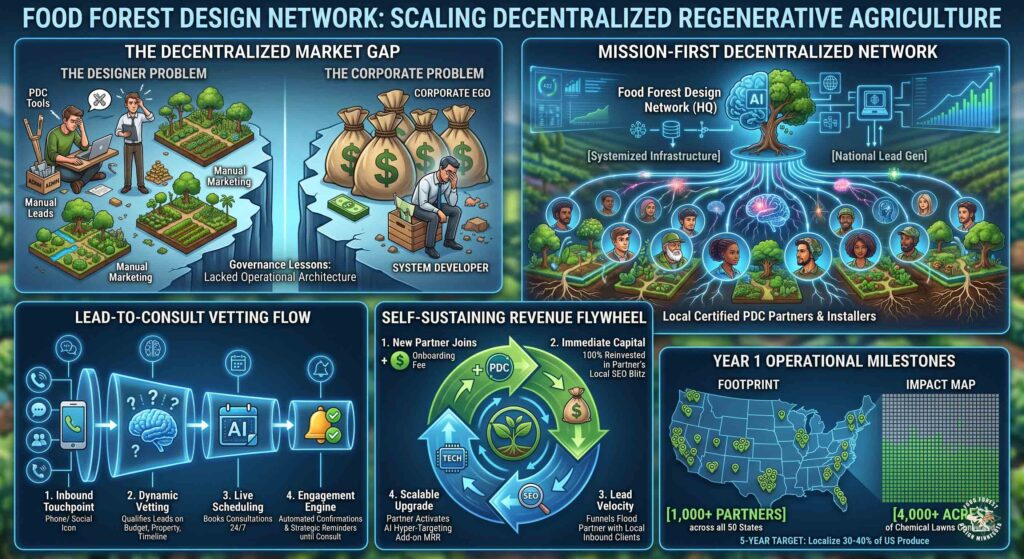
- The Decentralized Market Gap: This visual contrasts the isolated struggles of independent designers and early flawed corporate models, illustrating the systemic gap that the Food Forest Design Network addresses.
- Mission-First Decentralized Network: The Decentralized Market Gap: This visual contrasts the isolated struggles of independent designers and early flawed corporate models, illustrating the systemic gap that the Food Forest Design Network addresses.
- Mission-First Decentralized Network: This diagram maps the operational architecture, showcasing how HQ handles the macro-strategy, systems, and national lead generation to empower local PDC-certified partners and installers.
- Lead-to-Consult Vetting Flow: This infographic tracks the high-velocity, automated customer journey, from inbound touchpoint through dynamic AI vetting, live scheduling, and automated reminders, ensuring local partners only receive qualified appointments.
- Self-Sustaining Revenue Flywheel: A visual guide demonstrating the Network’s self-funding model: new partner onboarding fees immediately fund local SEO blitzes, driving rapid lead velocity and motivating high-margin SaaS upgrades.
- Year 1 Operational Milestones: This panel uses a geographic map and an acreage grid to visually track the critical dual metrics of Network Footprint (1,000+ Partners) and Acreage Under Management (4,000+ Acres) by the close of Year 1.
Technical Infrastructure of the Network
The Food Forest Design Network is a proprietary, AI-powered automation and CRM platform built exclusively to scale local food production across the United States.
- Replicated Digital Footprints: Every network member receives branded, pre-built replicated websites, landing pages, and marketing funnels optimized for local lead conversion.
- National Business Directory: A comprehensive, searchable marketplace directory mapping out related industries, including permaculture designers, organic farmers, homesteaders, and sustainable builders, giving each member a premium, high-visibility digital listing.
- Unified Enterprise Portal: A centralized business-in-a-box dashboard allowing operators to manage active client pipelines, access design assets, and review financial metrics seamlessly.
- Pre-Trained AI Office Assistants: Custom-trained AI agents manage intensive back-office operations, running an automated, 24/7 inside sales and administrative funnel that optimizes the entire front-end client lifecycle.
Rather than forcing local designers to chase unvetted inquiries, the AI Assistant handles the administrative heavy lifting automatically.
- Real-Time Qualification: The AI dynamically converses with prospects over web chat, social media, or email to verify budget alignment, property acreage, and project readiness before moving forward.
- Frictionless Booking & Confirmation: Qualified leads are automatically guided to select open slots synced directly from the local partner’s real-time calendar. Upon booking, the AI delivers an instant context handoff report directly to the installer.
- Strategic Reminder Engine: To maximize attendance, the AI executes automated text and email confirmations, follows up with educational reminders up until the hour of the consultation, and handles any cancellations or rebooking requests without human intervention.
The Self-Sustaining Financial Flywheel
To maximize scalability and compound investor returns, the Network incorporates a zero-waste capital design. Instead of treating partner onboarding fees as pure corporate profit, the vast majority of the Onboarding & Setup Fee, a full 75%, is immediately reinvested directly into the new partner’s local market.
The remaining 25% directly covers the expert development time required for custom portal provisioning and foundational network overhead. The core 75% allocation is deployed straight into the Network’s local SEO engines. This ensures that from day one, the partner’s local digital presence is flooded with high-intent customer inquiries, validating their investment instantly and securing long-term retention.
The Dual-Engine Revenue Model: High-Margin Services Scaled via SaaS
The network’s economic architecture fuses High-Yield Ecological Development Projects with an Automated SaaS Growth Engine, driving revenue through multiple parallel channels.
Engine 1: Premium Service Delivery & Discretionary Control
The primary economic driver remains the physical monetization of food forest designs, installations, and regional food production systems
- The Revenue Split Model: When an inbound residential or commercial project is secured through the Network’s national marketing engine, it is routed to a certified local PDC partner. The Network retains a streamlined percentage of both the design contract and the installation value for generating the lead and providing the technical framework.
- Full Project Control: For high-profile, high-yield, or large-scale community and municipal projects, the Network retains full project execution rights at its discretion, capturing 100% of the project revenue and utilizing its vast national collective of veteran designers as specialized contractors.
Engine 2: Compounding SaaS & Add-on MRR
The software infrastructure acts as a low-overhead operator acquisition engine, generating highly predictable Monthly Recurring Revenue (MRR).
- Base Platform Subscriptions: Network members pay a predictable monthly fee to unlock their replicated websites, integrated CRM tools, and enterprise portal access.
- AI Infrastructure Leases: Members subscribe to utilize the pre-trained AI Office Assistants, offloading front-office prospecting and qualification costs for a fraction of the expense of a human employee.
Premium AI Local SEO Hyper-Targeting (The Scaling Add-on)
Utilizing programmatic AI infrastructure, the Network offers an elite add-on subscription tier that automatically generates, optimizes, and updates neighborhood-level landing pages and synchronized social media content. This premium tier transforms the partner’s channels into automated lead-generation powerhouses while yielding exceptionally high software-scale margins for the Network.
Macro Market Vision: The Modern Victory Garden
This business model leverages a historically validated blueprint. During World Wars I and II, the United States government initiated the “Victory Garden” movement, calling upon citizens to transform residential yards into productive agricultural spaces. The result was an extraordinary success, where nearly 40% of all fresh produce consumed in the United States was grown directly at home or in neighborhood plots.
Food Forest Design Minnesota is deploying the modern iteration of this concept. By substituting manual, outdated business methods with high-velocity AI automation, the Network can rapidly scale residential and commercial edible landscapes. Within five years, this decentralized network will have the systemic capability to return 30% to 40% of all United States fruit and vegetable production to the local or regional level, decoupling communities from fragile supply chains and returning absolute food security to the household level.
Leadership Profile: Travis Holzem – Owner & Founder
Travis Holzem is the operational architect behind the Food Forest Design Network. A Marine Corps Desert Storm veteran, Holzem brings the rigorous discipline, tactical execution, and strategic focus of military leadership to the agricultural technology sector. As a single father who successfully raised three sons, his commitment to systemic stability, generational health, and food security is driven by a profound personal mission.
With a 25-year professional background spanning web design, advanced Search Engine Optimization (SEO), graphic design, and automated online marketing systems, Holzem uniquely bridges the gap between complex digital infrastructure and regenerative ecology. He is the technical developer who built the backend backbone of previous network attempts in this industry.
Having witnessed firsthand how corporate structural failures, executive insulation, and the dismissal of technical expertise can stall explosive growth, he engineered the Food Forest Design Network specifically to eliminate those operational gaps. Guided by a daily health, fitness, and weight-training regimen, Holzem leads with high physical capability and absolute operational transparency, focusing entirely on scaling a sustainable legacy.
Institutional Inquiries
Food Forest Design Minnesota and the Food Forest Design Network represent the intersection of enterprise software efficiency and critical physical infrastructure. By systemizing the fragmented permaculture market and offering a high-margin vertical to the landscaping industry, this model achieves rapid scalability with an optimized capital burn rate.
For institutional investment inquiries, detailed pro forma financial statements, and advanced technical breakdowns of the AI-powered CRM architecture, contact the corporate development desk.
Contact Information:
Travis Holzem, Founder
Food Forest Design Minnesota