Travis Holzem - Founding Partner of Food Forest Abundance & Owner of FFA Minnesota -
Please support my mission to solve food insecurity and transform inner city communities into thriving self-sustaining regenerative and abundant urban havens, while reducing crime. Food forests can enhance biodiversity, protect soil and water, promote beneficial insects, and provide access for everyone to healthy locally grown food without the use of harmful GMOs and pesticides. Visit my
GiveSendGo Page
Building the Infrastructure for a Nationwide Food Forest Economy Food Forest Design Minnesota is building a nationwide food forest network designed to connect qualified designers and installers with customers, technology, training, business infrastructure, and one another. The idea grew from work already happening here in Minnesota. Food Forest Design Minnesota has completed food-forest designs and…
A practical framework for healthier communities, stronger local economies, and pilot-ready solutions across Minnesota. Minnesota local food resilience begins with an embarrassingly simple idea: help people grow healthy, poison-free food where they live. Bill Mollison, one of the founders of permaculture, said: “Though the problems of our world are increasingly complex, the solutions remain embarrassingly…
J. Russell Smith was one of the earliest modern advocates for perennial agriculture and productive tree-based farming. Long before people widely used terms such as regenerative agriculture, agroforestry, and food forest design, he challenged farmers and land managers to reconsider how agriculture should interact with the land. Joseph Russell Smith was an American economic geographer,…
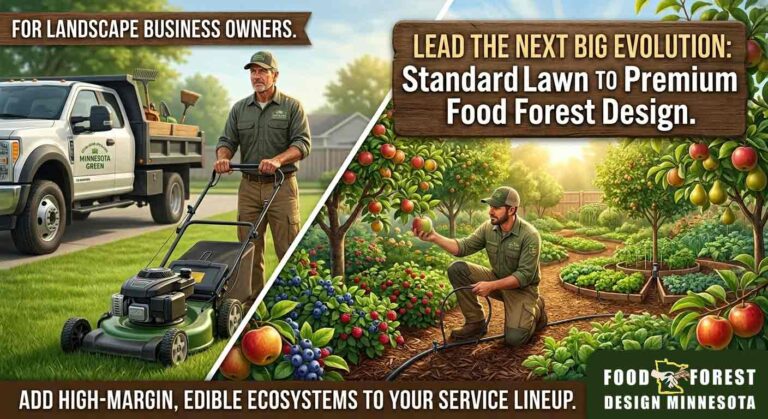
As a landscape business owner, you’ve put in the blood, sweat, and tears to build a solid operation. You have the crews, the equipment, and the local trust. You know how to execute. But as the world changes, homeowners are looking for something more than just a manicured lawn. Inflation, supply chain worries, and a…
MINNEAPOLIS, MN – The global food supply chain is facing an unprecedented convergence of vulnerabilities. Topsoil depletion, chemical-heavy industrial agricultural models, geopolitical instability, and extreme weather disruptions are forcing a systemic reckoning. Consumers, communities, and institutional developers are actively demanding a shift toward decentralized, organic, toxin-free food security. Yet, the traditional landscaping and agricultural…
Have you ever looked at your backyard and wondered why it’s just grass? You have the space, and you have the desire for fresh organic produce, but something is holding you back. You aren’t alone. In Minnesota, the journey to grow your own Food comes with unique challenges, from our short seasons to the local wildlife…
Food forest landscaping for real estate is the future of property development, rental housing, commercial spaces, and municipal land use. By replacing passive ornamental landscapes with productive food forests, water catchment, and energy capture, property owners can create more valuable, resilient, and attractive living spaces.
America once turned to Victory Gardens during times of crisis. Today, rising food prices, fragile supply chains, and food insecurity are reminding us that food security starts at home. A modern food forest can help families turn ordinary yards into productive, resilient food systems.
Food forest landscape design is often misunderstood as simply planting a few fruit trees, berry bushes, herbs, and flowers in a yard. From the outside, it may look like a beautiful edible landscape. Underneath that beauty, however, is a much deeper system of planning, ecology, strategy, and long-term land stewardship. A true food forest is…
If you have ever looked at your yard and thought, “This space could be doing more,” the DIY Food Forest Design Blueprint was created for you. Most yards are underused. They get mowed, watered, fertilized, and maintained week after week, but they rarely give anything meaningful back. A traditional lawn may look clean, but it…
The Twin Cities are experiencing a shift, and it’s not just the weather patterns we’ve all noticed. Our USDA Plant Hardiness Zone is changing, officially moving from 4b to 5a. For those of us with green thumbs (or those aspiring to have them!), this is a significant development that impacts what we can grow and…
Edible landscape Installation is more than just planting a few fruit trees in your yard. It’s a holistic approach to gardening that integrates aesthetically pleasing and functional elements to create a beautiful and productive landscape. By strategically incorporating edible plants into your garden design, you can enjoy fresh, homegrown produce while enhancing the beauty of…